Despite its recent popularity, the Corpse Reviver No. 2 was once on the edge of extinction, as were most corpse revivers and classic cocktails in general. But thankfully, today, you can order a Corpse 2 at almost any craft cocktail bar, at least in Seattle, and you will receive basically the same delicious drink. Sure, subtle differences might crop up depending on a bartender's choices as far as the proportions, the garnish, the brand of gin or absinthe, whether to use Cocchi or Lillet, or even to rinse or not to rinse--the list is endless. But at the end of the day, those four main ingredients--gin, lemon juice, Lillet, and Cointreau--and that fabulous dash of absinthe that pulls it all together are what define the Corpse 2. That is, unless your bartender learned the Corpse Reviver from Trader Vic's Bartending Guide.
Somewhere along the line another corpse reviver entered the scene. It's not really that surprising, as versions of everything come and go. But this isn't just any old drink that would revive just any old corpse--this cocktail is identical to the Savoy Corpse Reviver No. 2 that we all know and love, except that it substitutes Swedish punsch for the Lillet. I can honestly say I never saw that coming.
Swedish punsch and Lillet are hardly alike. Even if you take into account the mystery that is the 1930s variation of Lillet that Harry Craddock used in his original recipe, the difference would still have been huge. Lillet is a wine-based aperitif that is mildly sweet and has a dominant citrus flavor. Swedish punsch, or at least the version I make at home, is made from a combination of rum and batavia arrack that has been infused with lemon and sweetened with tea syrup. Night and day, those two are.
The other ingredients in the two recipes are identical, even down to the equal proportions. The smidgen of absinthe is even there. As far as where this Corpse Reviver No. 2a came from, Erik Ellestad at Underhill-Lounge has some theories that sound very reasonable to me: he blames/thanks Trader Vic Bergeron.
Corpse Reviver No. 2a ( as adapted fromTrader Vic)
3/4 ounce gin
3/4 ounce Cointreau
3/4 ounce lemon juice
3/4 ounce Underhill punsch
1 dash absinthe
Shake ingredients in an ice-filled shaker. Strain into a chilled cocktail glass.
Notes on Ingredients: I used Bellringer gin and Absinthe Verte de Fougerolles.
So let's cut to the chase already: what's different? The Corpse 2a is a tad sweeter and the Swedish punch definitely influences the overall flavor. But all in all, this libation is still well-balanced, refreshing, yummy, and very recognizable as a Corpse 2 variation. The tea notes, especially the tannins, stood out against the background of lemon and gin and played well alongside the tart, herbal flavors. The Cointreau seemed to play a larger role in the overall taste than it usually does in a Corpse 2, which is strange because the Lillet's orange notes are absent. The Corpse 2a is a pleasant change up from the norm that I would definitely recommend.
6.02.2011
6.01.2011
Time for Rhubarb: A Recipe for Rhubarb Shrub
As soon as the days start to lengthen, I feel compelled to visit the farmer's market. Usually I just wander among the stalls to check out what's fresh and available. Sometimes, I come home empty-handed. But on days when the fruits and vegetables inspire me, I leave with bags full of ideas and produce. On one recent Saturday morning, Tracy and I made our way over to the University District farmer's market. It was a pleasant Spring morning with the sun shining just enough to keep the morning chill mostly at bay. After some pastries and coffee, we began to take in the highlights. What caught my eye was the rhubarb, fat red stalks piled high. I wasn't sure what exactly to do with it, but I knew some of those stalks were coming home with me. Tracy's eyes lit up. too, and together we filled a small bag. When Tracy suggested that I make some rhubarb shrub, I instantly knew she was on to something--those stalks were destined to meet vinegar.
Every summer I make shrubs. I love their vinegary sweetness, and the beautiful way they preserve summer fruits for year-round consumption. In a way, winter seems a bit shorter with shrub around. Adding a bit of raspberry or apricot to a drink during those gray months is almost like magic. Almost. It's also pretty amazing how just a quarter ounce can totally change a drink, transforming its flavors into something new. Almost any fruit works in a shrub, and adapting the basic recipe is very easy. Usually on a whim, while I am roaming around the farmer's market, something stands out and it will be the newest shrub. This year, I seem to be starting with rhubarb.
In the past, I have always made hot-processed shrub, which entails simmering the fruit, sugar and water, and to a lesser extent, vinegar for a period of time. After cooling, you strain and bottle the resulting mixture and it's ready. Last year, I read about making shrubs without heat, which supposedly gives them a brighter flavor. I decided to attempt it with the rhubarb, and no exact recipe exists, I just adapted the different information I found online.
Rhubarb Shrub
10 3/4 ounces (by weight) chopped rhubarb10 3/4 ounces (by weight) natural sugar
10 3/4 ounces vinegar
1. Chop and weigh fruit.
2. Add an equal amount of sugar.
Notes: It doesn't matter if you use the same amount of raw materials that I did. Equal parts is the key, at least as far as a jumping off point. Fine-tuning may be required later. I chopped up the three stalks of rhubarb that I bought and then weighed the pieces. From there I just had to match proportions. After I added the sugar, I stirred it to coat all of the pieces. I also let it set for 15 minutes in the sugar so it would be easier to muddle. With a softer fruit this wouldn't be necessary.
2. Add an equal amount of sugar.
Notes: It doesn't matter if you use the same amount of raw materials that I did. Equal parts is the key, at least as far as a jumping off point. Fine-tuning may be required later. I chopped up the three stalks of rhubarb that I bought and then weighed the pieces. From there I just had to match proportions. After I added the sugar, I stirred it to coat all of the pieces. I also let it set for 15 minutes in the sugar so it would be easier to muddle. With a softer fruit this wouldn't be necessary.
3. Muddle fruit and sugar.
4. Macerate at room temperature for 24-48 hours.
Notes: Since rhubarb has the consistency of celery, I let the rhubarb macerate for 15 minutes before I muddled it. This allowed the sugar to start breaking down the toughness and made the muddling a lot more successful. Then I set it aside to macerate.
5. Add vinegar.
6. Cover and store at room temperature for a week.
Notes: When I added the vinegar, I also mixed it all up as much of the sugar had settled to the bottom. For the vinegar, I used mostly champagne vinegar as this is what I usually use for shrubs. Of course, I ran out, and had to add an ounce of apple cider vinegar to make up the difference. Then I covered the bowl with Saran wrap and put it back on the counter.
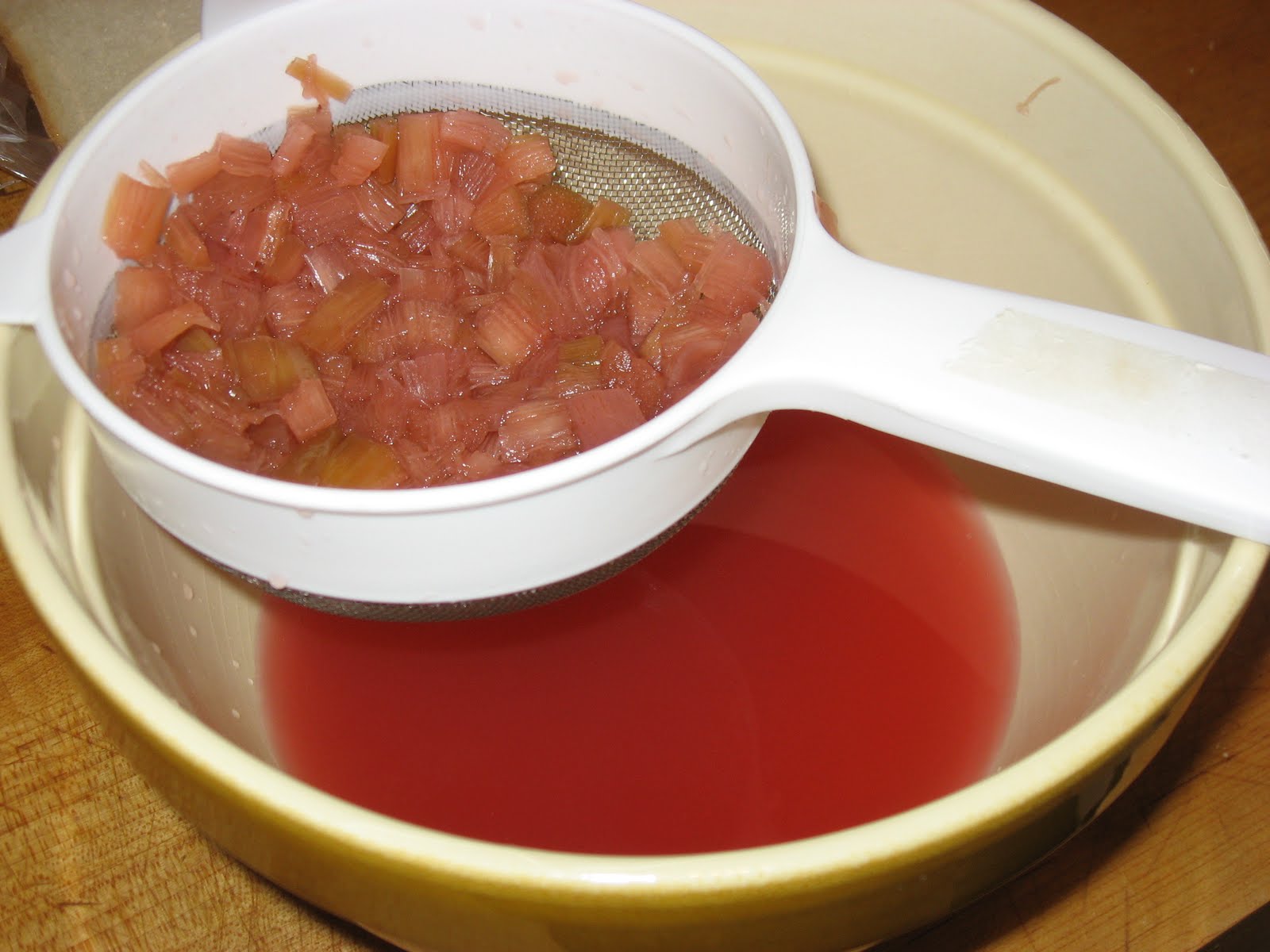
7. Strain mixture through a coarse or semi-coarse strainer.
8. Restrain through cheesecloth.
9. Bottle and store for at least more week before using.
Notes: Because I recently ran out of cheese cloth, and for some reason the grocery store was totally sold out, I bottled the shrub after the first strain. It needed to rest for a week anyway to allow the flavors to develop further. A week later, I strained the shrub through cheesecloth and rebottled it.
The real test of any shrub is in a drink. I know that when I taste tested the shrub it was mildly sweet and still quite vinegary. This would normally be the time for fine-tuning, adding sugar or vinegar to create a balance. But because I have never made this kind of shrub before, I wasn't sure if it was balanced. So instead of adding anything I just went with it. Here is a great aperitif recipe to use with any shrub--it is easy and delightful. I actually made it earlier in the Spring with blackberry shrub, and it was very tasty but it certainly was not as zippy and fruity as this aperitif was. I would highly recommend this as a great introduction to the glory of shrubs. Or you could make a rum shrub, which is quite nice as well.
Sherry Shrub (as adapted from alcademics.com, who adapted it from Neyah White's original recipe)
3/4 ounce shrub*
2 ounces manzanilla sherry
Stir in a mixing glass three-quarters full of ice and strain into a small cocktail glass. Garnish with orange or lemon twist.**
*Of course, I used rhubarb shrub here. I have used blackberry shrub in the past.
**I used an orange twist on a lark. I was out of lemons. The original recipe calls for lemon twist. I was pretty pleased with the orange though.
Subscribe to:
Posts (Atom)