As with any newly made syrup, the problem instantly becomes how do I use it? Fortunately since apples are so versatile, the potential applications seem endless--apple and citrus, apple and spice, apple and savory, apple and nutty. My only concern was that apples too often share the spotlight or simply act as the backdrop; they are hardly ever the star of the show. I was worried that somehow the syrups would not be robust enough and would get lost in the cocktail glass. In practice, this turned out to be a viable issue. While both syrups are quite robust on their own--the mulled apple cider syrup is especially delicious on oatmeal--in cocktails, the apple flavor was easily overwhelmed. But with some experimentation, I did have some rather surprising successes.
I have two "go-to" recipes when I am trying to figure out how to incorporate a new syrup into a cocktail: the old fashioned and the gimlet. Both allow the syrup's flavors to shine because there are fewer ingredients involved. Of course, the way that the syrup interacts with the specific flavor profile of a gin becomes the central issue. Because gin and apples in general work well together, I decided to start there. After discovering the relative delicacy of the syrup, I opted for a more traditional London dry gin. While an absinthe rinse is not usually included in a gimlet, it does add a nice element here that works indirectly to highlight the apple flavors.
Apple-let
2 ounces gin
1/2 ounce apple cider syrup
Express the oils of a thick lime peel into the shaker. Combine the peel with the other ingredients and shake with ice. Strain into a chilled absinthe-rinsed cocktail glass.
Notes on Ingredients: I used Whitley Neil gin and Pacifique absinthe.
The old fashioned seemed the perfect vehicle for the mulled apple cider syrup. The syrup's combination of fruit and spice propelled me toward barrel-aged spirits. Because of the many successful drinks pairing rye and apple brandy, rye was my first choice. But then again, I don't need an excuse to make a rye old fashioned. Unfortunately, this was not the best choice, as the apple flavors were easily overwhelmed. Though the drink was lovely, it could have just as easily been made with a cinnamon or clove syrup--not the ideal situation. I then tried brandy and a mellow rum and both were quite successful. At first the spices in the syrup came across strongest, but over time hints of apple started to peek out.
Variation on a Rum Old Fashioned
2 ounces rum
2 teaspoons mulled apple cider syrup
1 dash orange bitters
Combine syrup and bitters in a rocks glass. Add a large chunk of ice and pour in the rum. Stir to combine. Garnish with an orange peel. Optional: add an absinthe rinse to the glass before building the drink.
Notes on Ingredients: I used Plantation 5-year rum, Fee's barrel-aged orange bitters. I rinsed the glass with Pacifique absinthe.
As I started experimenting, I quickly discovered just how delicate my syrups were. For example, aquavit's more savory anise and caraway worked really well with the mulled syrup's warm cloves and cinnamon, but the apple completely disappeared. The apple cider syrup only acted as a sweetener. So I decided to utilize more delicate flavors. Gin softened with vermouth or sherry was much more successful. And a friend of mine recently discovered that the mulled apple cider syrup added a nice touch when used in a Manhattan. Adding vermouth or dry ingredients seemed to be the key to creating a successful cocktail.
Touch of Apple
1 1/2 ounces gin
3/4 ounce manzanilla sherry
1/2 ounce apple cider syrup
1/4 ounce Calisaya liqueur
Combine ingredients in an ice-filled mixing glass. Stir and strain into a chilled cocktail glass. Garnish with a lemon twist.
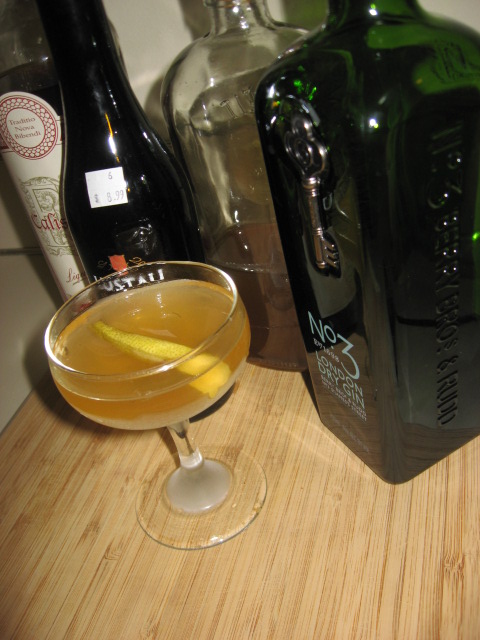
Notes on Ingredients: I used No. 3 gin and Lustau dry manzanilla sherry.
1.10.2013
12.31.2012
Barrel-Aging Cocktails: Claridge Cocktail
A barrel is a naturally evolving environment. As a spirit ages, the organic nature of the wood allows oxygen to interact with all of the components to create those unique, wonderful flavors we know and love. While Bourbon must be aged, by law, in new barrels, many other aged spirits, such as scotch, Canadian whisky, and even rum, depend on flavors that have been captured in a used barrel. Each time an unaged spirit is added to a used barrel, the spirit's aging process will be informed by what was in the barrel beforehand. This is a particularly important considering how vastly different a spirit that has been aged in a new barrel is from a spirit aged in a used barrel. Even finishing a spirit, which typically requires aging the spirit for at least two years in a different barrel, such as a sherry butt or port cask, can be used to layer in yet other flavors. Even something as small as the specific mash bill of a bourbon can greatly affect the flavors in a barrel that a white spirit can access while it rests.
During barrel-aging, the flavors of the wood are infused into the white spirit. But this is only half of the equation. The flavors of the spirit are also suffused into the wood. Thus, when a subsequent new make spirit is added, the flavors of any earlier finished products will be imparted. But this is not an infinite process. As a barrel is reused, its own flavors are leeched away. Over time a neutral environment will result. Each liquid added to the barrel exists in its timeline. And when the product is taken out of a barrel it will not only represent a fixed point in the life cycle of the barrel, but it will also carry the impression of the barrel's history. I never really understood just how this worked until I started experimenting with my own small barrel.
The process is fascinating. The first spirit I aged would be the only one that would be 100 percent affected by the barrel. Because of this, the initial decision-making process is incredibly streamlined. Short of temperature and location decisions, the only remaining decision is when to empty the barrel. It was simply a question of time and taste. But every choice after that would get incrementally more complex. The pisco I added to the barrel second has trace flavors of the rum I started with. The El Presidente cocktail that came next was influenced by both the pisco and the rum. As I started to understand how each decision impacted the next, my choices became more complex and more interesting. The effects of the flavors already in the barrel and how they would influence the next project needed to be accounted for. What kind of cocktail would benefit most from what had come before? This became the underlying theme of the entire process.
Enter the Claridge
I was first introduced to the Claridge Cocktail at a friend's house a couple of years ago. His knowledge of classic cocktails to this day exceeds my own, and I was happy to taste any beverage, new or old, that had captured his attention. For me it was the apricot brandy that made the cocktail so interesting. And yet it was such an old drink. But then again, I have always had a soft spot for classics.
Gary Regan outlined his opinions about the origins of the Claridge a couple of years ago in the San Francisco Chronicle. His research brought him from Harry Craddock's Savoy Cocktail Book, where I first discovered it, to Harry McElhone's 1927 Barflies and Cocktails. McElhone attributes it to "Leon, Bartender, Claridge's Hotel, Champs Elysee." Unfortunately, the trail runs cold thereafter.
Given that the flavors of the El Presidente are bright and fruity, the Claridge seemed like a natural choice to follow it into the barrel.
Claridge Cocktail
1 ounce gin
1 ounce dry vermouth
1/2 ounce apricot brandy
1/2 ounce Cointreau
Combine ingredients in an ice-filled mixing glass. Stir and strain into a chilled cocktail glass.
Notes on Ingredients: I used Gordon's gin, Bitter Truth apricot brandy, and Dolin dry vermouth.
Fruity and bright, this is a cocktail that depends on the apricot brandy for its success. Delicate, yet still spirit forward, the Claridge is a perfect cocktail to use to test apricot brandies. Being the second cocktail that followed two spirits in my barrel, even after three months the influence of the barrel was slight. The oak of the barrel could be discerned as a hint in the after taste. A certain berry note from the grenadine in the El Presidente was apparent in the mid-palate. But it was an undercurrent of funk from the Wray and Nephew, still apparent after so much time, that hinted at the history of the barrel contained in this new cocktail.
During barrel-aging, the flavors of the wood are infused into the white spirit. But this is only half of the equation. The flavors of the spirit are also suffused into the wood. Thus, when a subsequent new make spirit is added, the flavors of any earlier finished products will be imparted. But this is not an infinite process. As a barrel is reused, its own flavors are leeched away. Over time a neutral environment will result. Each liquid added to the barrel exists in its timeline. And when the product is taken out of a barrel it will not only represent a fixed point in the life cycle of the barrel, but it will also carry the impression of the barrel's history. I never really understood just how this worked until I started experimenting with my own small barrel.
The process is fascinating. The first spirit I aged would be the only one that would be 100 percent affected by the barrel. Because of this, the initial decision-making process is incredibly streamlined. Short of temperature and location decisions, the only remaining decision is when to empty the barrel. It was simply a question of time and taste. But every choice after that would get incrementally more complex. The pisco I added to the barrel second has trace flavors of the rum I started with. The El Presidente cocktail that came next was influenced by both the pisco and the rum. As I started to understand how each decision impacted the next, my choices became more complex and more interesting. The effects of the flavors already in the barrel and how they would influence the next project needed to be accounted for. What kind of cocktail would benefit most from what had come before? This became the underlying theme of the entire process.
Enter the Claridge
I was first introduced to the Claridge Cocktail at a friend's house a couple of years ago. His knowledge of classic cocktails to this day exceeds my own, and I was happy to taste any beverage, new or old, that had captured his attention. For me it was the apricot brandy that made the cocktail so interesting. And yet it was such an old drink. But then again, I have always had a soft spot for classics.
Gary Regan outlined his opinions about the origins of the Claridge a couple of years ago in the San Francisco Chronicle. His research brought him from Harry Craddock's Savoy Cocktail Book, where I first discovered it, to Harry McElhone's 1927 Barflies and Cocktails. McElhone attributes it to "Leon, Bartender, Claridge's Hotel, Champs Elysee." Unfortunately, the trail runs cold thereafter.
Given that the flavors of the El Presidente are bright and fruity, the Claridge seemed like a natural choice to follow it into the barrel.
Claridge Cocktail
1 ounce gin
1 ounce dry vermouth
1/2 ounce apricot brandy
1/2 ounce Cointreau
Combine ingredients in an ice-filled mixing glass. Stir and strain into a chilled cocktail glass.
Notes on Ingredients: I used Gordon's gin, Bitter Truth apricot brandy, and Dolin dry vermouth.
Fruity and bright, this is a cocktail that depends on the apricot brandy for its success. Delicate, yet still spirit forward, the Claridge is a perfect cocktail to use to test apricot brandies. Being the second cocktail that followed two spirits in my barrel, even after three months the influence of the barrel was slight. The oak of the barrel could be discerned as a hint in the after taste. A certain berry note from the grenadine in the El Presidente was apparent in the mid-palate. But it was an undercurrent of funk from the Wray and Nephew, still apparent after so much time, that hinted at the history of the barrel contained in this new cocktail.
Labels:
apricot brandy,
barrel-aging,
cointreau,
gin,
vermouth (dry)
Subscribe to:
Posts (Atom)