3.19.2013
The Martinez in Depth: Byron's Sweet Martinez
This past week, I have been pondering the changes my tastes have undergone over the last five years as I grew more interested in and moderately obsessed with the world and history of cocktails. Where once I couldn't stomach the "astringency" of gin, the floral nature of scotch, or even "menthol" flavors of tequila, in the intervening years, I have learned to love all three. I even successfully conquered my revulsion for all things anise. But these changes did not happen overnight. While perhaps the most important factor may have been having an open mind, certainly some cocktails or experiences played greater roles than others. The Vesper may have been the first gin-based cocktail that I actually enjoyed, that in and of itself could have been a fluke. After all, one singular experience does not alter one's taste from yuck to yum.
The gin drink that kept me coming back for more is the Martinez--that dusty old cocktail often included on menus today despite its checkered past. I wish I had some great moment of discovery, some memory where every detail resonated, but I cannot place either the circumstances or the location of my first sip. Two winters ago it was my go-to cocktail, and I could often be found starting the evening with a Martinez. It seemed like I drank one at every cocktail establishment I visited over the course of many months. Some were dryer, more modern representations. Others were richer, bearing the stamp of Carpano Antica in generous amounts. I have had every garnish available, from orange twists to olive ,or even nothing at all. I have had historically accurate renditions that harken back to Jerry Thomas's 1887 recipe, where the sweet vermouth carries the bulk of the volume. And I even consumed a Martinez that was "tossed"--where the ingredients are aerated as the bartender essentially pours the mixture back and forth from tin to tin blue-blazer style. When it comes to the proportions, choice of ingredients, or even method, the defining feature of any given Martinez depends almost entirely on the bartender's whim. It seems it has always been this way. But after considering all of these experiences, I had to conclude that my current love of gin is inextricably linked to my love of this drink.
History
Before vermouth really took off, almost every cocktail was directly related to the Old Fashioned--some form of spirit, sweetening agent, bitters, and ice. As this drink and the burgeoning cocktail market evolved, liqueurs and flavored syrups crept into the glass. This led to such creations as the Japanese Cocktail and the Fancy Brandy Cocktail. By the 1880s, absinthe had fomented its place as a key ingredient in the Sazerac, another Old Fashioned variation, and had even impacted the original cocktail recipe, as evidenced by its inclusion in the Improved Whiskey Cocktail, which first appeared in print in Jerry Thomas's 1887 reprint of the Bar-Tender's Guide. Other liqueurs, such as maraschino, that were widely used in punches were also making their way into the cocktail vernacular. All in all, the evolution of the cocktail seemed fairly straightforward.
Everything changed when Italian vermouth began making its way into the country. The popularity of vermouth-based cocktails is evidenced by their inclusion in O.H. Byron's Modern Bartender's Guide (1884), Jerry Thomas's 1887 edition of the Bar-Tender's Guide, and George Kappeler's Modern American Drinks (1895). Americans quickly became infatuated with the various ways this aromatized, fortified wine interacted with their favorite spirits. The world of cocktails would never be the same.
While the Martini and Manhattan became two of the most famous cocktails ever concocted, the Martinez's chances stalled as popular trends and industrial innovations shifted tastes away. Eventually history would only remember its recipe as a footnote in one of the Martini's various origin stories--that is, until cocktail historians and bartenders resurrected it. Though the exact details are lost to history, the Martinez's birth is undoubtedly linked with the experimentation that followed Italian vermouth's explosion in American markets.
Like its more famous cousins, the Martinez did not begin with a recognized recipe. Early vermouth-based cocktails were highly dependant on the whim of the bartender. In the late nineteenth century, even published recipes for a Manhattan allowed for differing ratios between the rye and sweet vermouth as well as the amount and type of bitters. Many authors even called for the inclusion of a sweetening agent, such as gum syrup or orange curacao. In these early days the Martinez's recipe was very obviously linked to the Manhattan. In fact often the two cocktails were identical except for the base spirit.
O.H. Byron and the Missing Maraschino
The Martinez first showed up in print in 1884 in O.H. Byron's Modern Bartender's Guide. Nestled up underneath the entry for the Manhattan, it is easy to overlook. While the Manhattan easily takes up half the page with its dry and sweet variations. The Martinez's recipe is succinct, involving only one sentence: "Same as Manhattan, only you substitute gin for whisky." Because early beverage guides were more heavily reliant on drink styles, such as a daisy or a smash, as opposed to individualized cocktail recipes, this cross-referencing was not uncommon. However, no other cocktail is dealt with in this manner. It is easy to understand how a Gin Crusta related to a Brandy Crusta. In those cases, too, the drinks would be practically identical down to the elaborate garnish, but all this started to change with vermouth-based cocktails. While the Martinez is simply a Gin Manhattan, the fact that it does have its own name and internal variances based on vermouth style sets it apart.
O.H. Byron's Martinez
2 dashes Curacoa [1/4 ounce]
2 dashes Angostura bitters
1/2 wine-glass gin [1 ounce]
1/2 wine-glass Italian vermouth [1 ounce]
Fine ice; stir well and strain into a cocktail glass
[garnish with an orange twist]
Notes on Ingredients: I used Ransom Old Tom Gin, Pierre Ferrand Dry Curacao, and Angostura Bitters. As I only had Dolin sweet vermouth on hand, I bumped up the flavor profile with Bonal in a 2:1 ratio.
Even though this recipe is the first one in print, if you walk into a craft cocktail bar today and order a Martinez, this is not what you will receive. In most circumstances you will receive something very similar. While both cocktails rely heavily on their large proportions of gin and sweet vermouth, one will include a splash of maraschino liqueur instead of the other's curacao. For whatever reason, the Martinez that has been revitalized is not the one from Byron's pages. History has, instead, taken a shining to Jerry Thomas's version.
Curacao had been used in cocktails for years before maraschino liqueur became a popular cocktail ingredient. While more than a handful of Byron's recipes call for maraschino liqueur, the Martinez isn't one of them. A curious side note is that two versions of the Fancy Brandy Cocktail are included, one containing curacao, the other maraschino. Perhaps it was just a question of time before maraschino was substituted for the curacao in a Martinez.
As written, the drink is incredibly tasty. While the wonderful interaction between the herbaceous gin and the maraschino's funky cherry and almond flavors are definitely missing, there is something so wonderfully simple about the addition of the orange notes.
1.10.2013
Using Homemade Ingredients: Apple Cider Syrup
As with any newly made syrup, the problem instantly becomes how do I use it? Fortunately since apples are so versatile, the potential applications seem endless--apple and citrus, apple and spice, apple and savory, apple and nutty. My only concern was that apples too often share the spotlight or simply act as the backdrop; they are hardly ever the star of the show. I was worried that somehow the syrups would not be robust enough and would get lost in the cocktail glass. In practice, this turned out to be a viable issue. While both syrups are quite robust on their own--the mulled apple cider syrup is especially delicious on oatmeal--in cocktails, the apple flavor was easily overwhelmed. But with some experimentation, I did have some rather surprising successes.
I have two "go-to" recipes when I am trying to figure out how to incorporate a new syrup into a cocktail: the old fashioned and the gimlet. Both allow the syrup's flavors to shine because there are fewer ingredients involved. Of course, the way that the syrup interacts with the specific flavor profile of a gin becomes the central issue. Because gin and apples in general work well together, I decided to start there. After discovering the relative delicacy of the syrup, I opted for a more traditional London dry gin. While an absinthe rinse is not usually included in a gimlet, it does add a nice element here that works indirectly to highlight the apple flavors.
Apple-let
2 ounces gin
1/2 ounce apple cider syrup
Express the oils of a thick lime peel into the shaker. Combine the peel with the other ingredients and shake with ice. Strain into a chilled absinthe-rinsed cocktail glass.
Notes on Ingredients: I used Whitley Neil gin and Pacifique absinthe.
The old fashioned seemed the perfect vehicle for the mulled apple cider syrup. The syrup's combination of fruit and spice propelled me toward barrel-aged spirits. Because of the many successful drinks pairing rye and apple brandy, rye was my first choice. But then again, I don't need an excuse to make a rye old fashioned. Unfortunately, this was not the best choice, as the apple flavors were easily overwhelmed. Though the drink was lovely, it could have just as easily been made with a cinnamon or clove syrup--not the ideal situation. I then tried brandy and a mellow rum and both were quite successful. At first the spices in the syrup came across strongest, but over time hints of apple started to peek out.
Variation on a Rum Old Fashioned
2 ounces rum
2 teaspoons mulled apple cider syrup
1 dash orange bitters
Combine syrup and bitters in a rocks glass. Add a large chunk of ice and pour in the rum. Stir to combine. Garnish with an orange peel. Optional: add an absinthe rinse to the glass before building the drink.
Notes on Ingredients: I used Plantation 5-year rum, Fee's barrel-aged orange bitters. I rinsed the glass with Pacifique absinthe.
As I started experimenting, I quickly discovered just how delicate my syrups were. For example, aquavit's more savory anise and caraway worked really well with the mulled syrup's warm cloves and cinnamon, but the apple completely disappeared. The apple cider syrup only acted as a sweetener. So I decided to utilize more delicate flavors. Gin softened with vermouth or sherry was much more successful. And a friend of mine recently discovered that the mulled apple cider syrup added a nice touch when used in a Manhattan. Adding vermouth or dry ingredients seemed to be the key to creating a successful cocktail.
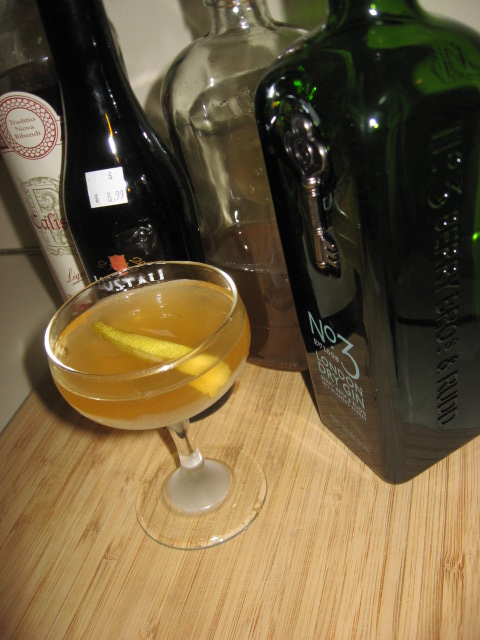
Touch of Apple
1 1/2 ounces gin
3/4 ounce manzanilla sherry
1/2 ounce apple cider syrup
1/4 ounce Calisaya liqueur
Combine ingredients in an ice-filled mixing glass. Stir and strain into a chilled cocktail glass. Garnish with a lemon twist.
Notes on Ingredients: I used No. 3 gin and Lustau dry manzanilla sherry.
Labels:
absinthe,
apple cider,
apple cider syrup,
bitters (orange),
calisaya liqueur,
gin,
mulling spices,
rum,
sherry
Subscribe to:
Posts (Atom)